Eliminate ruined slabs, premature diamond wear, and inconsistent sheen levels. Get instant access to the exact tooling sequences, densifier dwell equations, and troubleshooting protocols used on multi-million dollar architectural floors.
Master
the Grind
Instant PDF Download · Spec-Sheet Compliant · 100% Practical Field Data

The Cost of Guesswork
Polishing without verified chemistry and grit metrics isn't craft — it's gambling. A single calculation error burns profit margins, ruins diamond tooling, and triggers catastrophic client rejections.
Ruined Slabs
Improper densifier penetration timing combined with wrong bond hardness creates micro-pitting, aggregate pop-outs, and deep scratches that force complete slab resurfacing.
Wasted Tooling
Running soft-bond segments on abrasive concrete or glazing hard metals on vitrified surfaces burns through thousands in diamond tooling in hours with near-zero stock removal.
Inconsistent Finishes
Random resin burns, cloudy sheen variations, and patchy DOI readings fail gloss specs, failing inspection and destroying contractor credibility on high-value commercial jobs.
Inside the Blueprint
Every protocol is engineered for predictable surface refinement. No vague theories: only tested head-pressures, grit sequences, and chemical application timings.
Why Concrete Polishing
The $8B market opportunity, why polished concrete outperforms coatings long-term, and how a single floor can generate recurring maintenance revenue for years.
Understanding Concrete
How PSI, water-cement ratio, moisture content, and finish level selection determine every tool and chemical decision you'll make on a job.
Equipment Guide
From walk-behind rental machines to full planetary systems — what to buy, when to buy it, and how to get commercial showroom results at every budget level.
Tooling & Pressure Blueprint
Engineering specs for the dual-direction triple-head planetary layout, head pressure calibration from 380–620 lbs, direct-drive vs. belt-driven torque profiles, and exact RPM-to-travel-speed ratios by tool type.
Precision Diamond Grit Matrix
A 10-row master matrix crossing concrete PSI, finish level, bond hardness, and complete grit sequence — the only reference you need at the tool staging area.
The Polishing Process
The full process from pre-job assessment through guard application, with grit progressions for all four finish levels and the densifier timing that makes or breaks the resin phase.
Chemical Hardener & Chemistry
Porosity-matched densifier titration tables, coverage formulas for densifier and guard, the hybrid resin transition protocol, RA surface roughness targets, and mirror burnishing speeds by RPM range.
Slurry Management
Containment setup, auto-extraction schematic, HEPA protocol with OSHA CFM requirements by machine size, and the exact impact of poor slurry management on tooling life and surface quality.
Crew QA & Grit Checklists
Two printable crew checklists with sign-off fields, the full chemical cure timeline for high-volume warehouse work, and the five-point final QA walkthrough your client will use to judge you.
Coatings Overview
Epoxy vs. polyaspartic, system selection by application type, and CSP requirements — everything you need to quote a coating job with confidence.
Pricing & Business Basics
The 7 cost components that must be in every bid, a market pricing reference from cream polish to metallic epoxy, and the maintenance contract close script that converts every finished floor into recurring revenue.
Rapid Troubleshooting Matrix
Three diagnostic matrices covering scratch pattern correction, coating failures, and equipment problems — cause identified, fix prescribed, no guessing.
Quick Reference
The 15-point job site checklist, bond selection card, grit progression cards for all four finish levels, condensed troubleshooting matrix, and the densifier volume formula — all on printable laminate-ready cards.
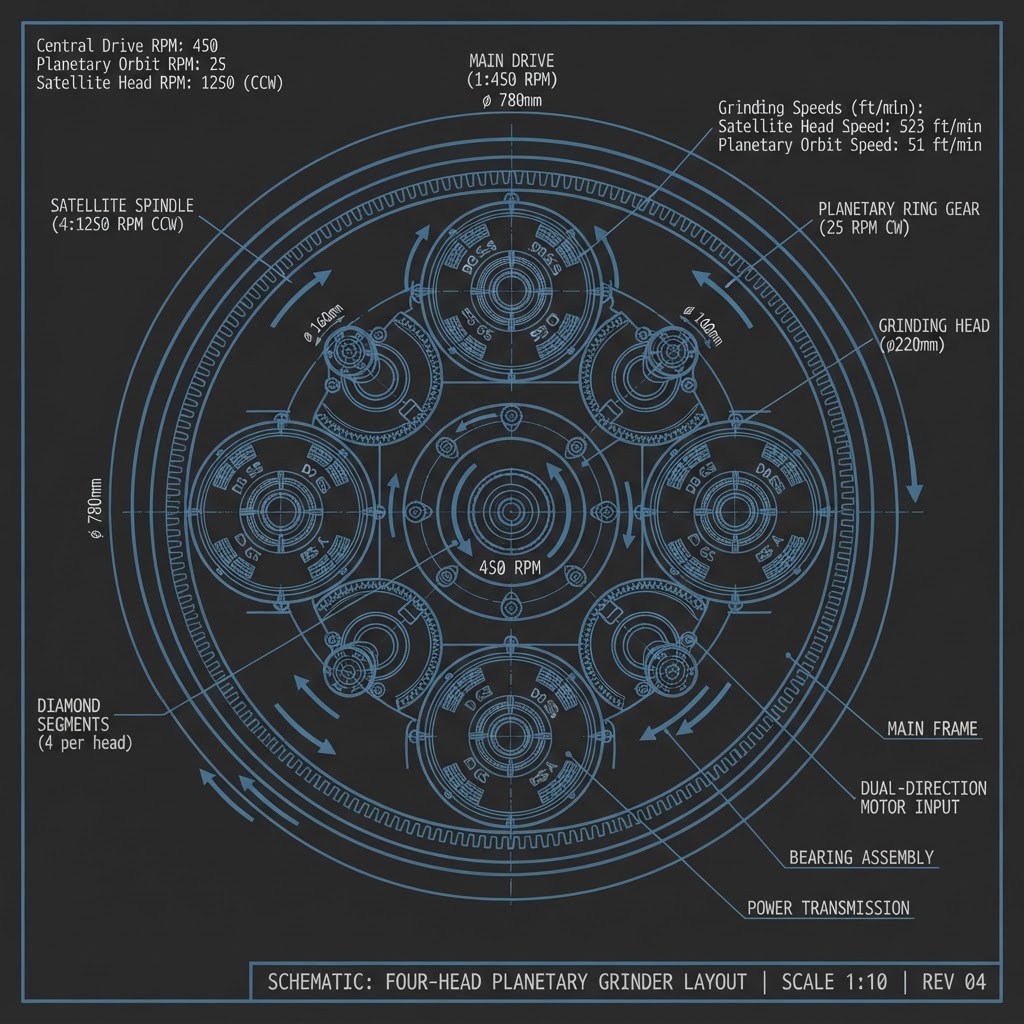
Engineering Specification: Dual-direction four-head planetary layout illustrated above. The guide details exact head RPM to travel speed ratios (ft/min) required to prevent swarf build-up and achieve deep clarity without wave distortion.
Engineered for Contractors
Whether you manage multi-crew commercial slabs, run a specialized architectural flooring outfit, or demand industrial-grade perfection on personal builds: this manual eliminates guesswork and locks in consistent, predictable finishes on every square foot.
Eliminate Sub-Contractor Bottlenecks
Stop waiting on specialty polishing subs. Train self-perform crews to execute high-volume warehouse and retail specs with strict grit sequences, chemical cure timelines, and repeatable QA inspections.
Dial in pH Levels & Specular Reflectivity
Advance past generic grind-and-seal jobs. Master chemical densifier titration, hybrid resin transitions, RA surface roughness measurement, and exact burnishing speeds for mirror finishes.
Architectural Finishes on Compact Gear
Achieve commercial showroom results using single-phase walk-behind rental machines. Includes slurry management, edge-grinding alignment, and lithium hardener application without costly heavy rigs.
Stop Guessing. Start Polishing.
Eliminate ruined slabs, premature diamond wear, and inconsistent sheen levels. Get instant access to the exact tooling sequences, densifier dwell equations, and troubleshooting protocols used on multi-million dollar architectural floors.
Instant PDF & Digital Spreadsheet Download · Free · No Recurring Fees

